The watch guide: case size, movement, and the strap
Published Oct 13, 2026 · Updated Oct 15, 2026 · By Iris, Pieces & materials editor
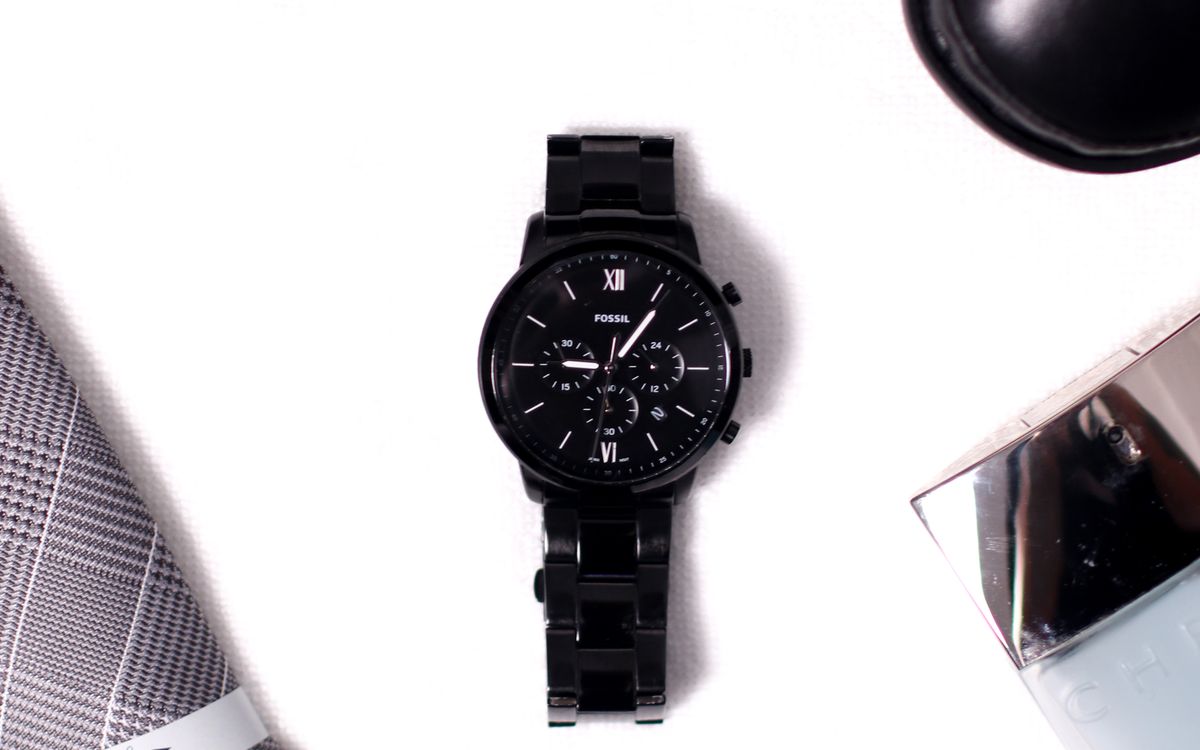
A watch is the accessory with the most specs per dollar, and the specs that matter aren’t the ones on the box. Case size decides whether the watch reads as deliberate or dominant. The movement decides how the watch behaves when you’re not wearing it. The strap decides which scenes the watch belongs to. Read those three in order and the choice gets simple.
Case size: the 38-40mm middle
The 38-40mm range is the versatile middle for a first real watch. A case in that range sits present under a shirt cuff without dominating it, and it works on wrists from about 6 to 7.5 inches without reading oversized. Past roughly 42mm, a watch starts reading as a sport watch — fine on a bracelet or rubber, odd under a dress-shirt cuff.
Diameter isn’t the whole story, though. Lug-to-lug — the full length, case tip to case tip — decides whether the case wraps your wrist or overhangs it, and thickness decides whether it slides under a cuff at all. A 40mm case with a 48mm lug-to-lug wears very differently from a 40mm case with a 45mm one. Measure your wrist, then compare both numbers against the spec sheet.
Automatic vs quartz: how each behaves
A quartz movement runs on a battery and a vibrating crystal; Seiko’s support documentation rates its quartz accuracy at ±15 seconds per month. An automatic winds itself from the motion of your wrist and is rated per day — looser than quartz in practice, with owner reports on Seiko’s own product pages describing daily drift ranging from a few seconds to 15-20 seconds a day.
What the automatic buys isn’t accuracy. It’s the mechanics: no battery changes, a sweeping seconds hand, and a movement that can be serviced rather than replaced. What the quartz buys is thinness and indifference — the Seiko Essentials pick below is 8.25mm thick because a battery doesn’t need a rotor. If you take the watch off for days at a time, a mechanical will stop and need resetting; a quartz won’t.
Both need maintenance, just different kinds. Automatics want a service every several years; quartz wants a battery every two to four years. Both want their gaskets replaced whenever the case is opened — a point that turns out to matter more than either.
The strap decides the scene
- Leather reads dress and office. It’s the right strap for anything at level 3 and up, and it’s the first thing to swap onto a sport watch.
- Nylon is the field-and-weekend strap: light, quick-drying, and it reads casual no matter what’s on the dial.
- Steel bracelet is the everyday default. It survives sweat and water and dresses up with the right case.
- Rubber is for water scenes and little else; it reads sport under everything.
What water resistance actually means
Ratings are static-pressure tests, not promises. On Seiko’s pages, 10 bar / 100 meters is the everyday-sport rating — swimming and snorkeling, not diving. 5 bar / 50 meters is splash-and-rain resistance: a wash-up sink, not a pool. 3 bar / 30 meters is barely weather.
The rating assumes the crown is screwed down and the gaskets are fresh, and both degrade. Gaskets dry and take the shape of the case; a crown knocked unscrewed undoes everything. That’s why a battery change should also be a reseal — if the case is opened without new gaskets, the number on the dial becomes fiction.
What we’d pick
Three watches, three roles, all in the size range that works:
- Seiko 5 Sports SRPH33 — the everyday automatic, at 39.4mm on a nylon strap.
- Seiko Presage Cocktail Time SRPK15 — the dress automatic, at 40.5mm on leather.
- Seiko Essentials SUR527 — the quartz alternative, thin, sapphire crystal, on steel.
The picks below break down what each one does on the wrist and where it earns its keep elsewhere. Prices and availability move — check the live listing before buying.
The picks
Some links below are affiliate links — we may earn a commission at no extra cost to you.
Seiko 5 Sports SRPH33
The everyday automaticA 39.4mm automatic in the Seiko 5 Sports line — the size range that reads deliberate under a shirt cuff instead of dominant. The 4R36 movement winds itself from your wrist, the nylon strap dries fast and reads casual, and the 100-meter rating makes it the one watch you can leave on all day. It's the default answer to 'one watch, most scenes'.
- + 39.4mm case sits in the versatile 38-40mm range
- + Automatic 4R36 with about 41 hours of power reserve — no battery
- + 100m water resistance; nylon strap handles water and sweat
- – Accuracy varies by unit; owner reports describe daily drift of a few seconds up to 15-20
- – Hardlex crystal scratches more easily than sapphire at this price
Seiko Presage Cocktail Time SRPK15
The dress automaticThe dress end of the same size range: a 40.5mm Presage with a pressed-pattern dial and a brown leather strap. The 4R35 automatic and the leather strap put it at formality level 3 and up — it works under a cuff with a shirt that matters. The trade is water resistance: 50 meters, splash and rain only.
- + 40.5mm case with leather strap reads correctly for dress and office scenes
- + Automatic movement with the Cocktail Time dial — dress watch presence at an entry price
- + Box-shaped crystal and screw-down caseback for the money
- – 50m resistance — not a swimming watch, unlike the 5 Sports
- – 11.8mm thickness sits high under a tight cuff
Seiko Essentials SUR527
The quartz alternativeThe quartz argument in one watch: 40.2mm, 8.25mm thin, sapphire crystal, and a stainless bracelet. Seiko rates its quartz movements at ±15 seconds per month — tighter than any automatic here — and there's no rotor to stop when the watch sits in a drawer for a week. The 100-meter rating means it swims.
- + Quartz accuracy rated at ±15 seconds per month
- + Sapphire crystal and 8.25mm thin case; 100m water resistance
- + Steel bracelet works at every level from desk to weekend
- – Battery replacement every two to four years
- – Quartz seconds tick rather than sweep — a matter of taste, not accuracy
Comparison
How the three watches divide the roles.
| Seiko 5 Sports SRPH33 | Seiko Presage Cocktail Time SRPK15 | Seiko Essentials SUR527 | |
|---|---|---|---|
| Case size | 39.4 mm | 40.5 mm | 40.2 mm |
| Movement | Automatic 4R36 | Automatic 4R35 | Quartz 6N52 |
| Water resistance | 100 m | 50 m | 100 m |
| Strap | Nylon | Brown leather | Steel bracelet |
| Best scene | Everyday and weekend | Dress and office | Everyday, desk to water |
Prices and availability change — the buttons above check the current listing. Last verified October 2026.
Frequently asked questions
- Is a 42mm watch too big for me?
- It depends on your wrist and on the case's lug-to-lug more than on the diameter alone. The 38-40mm range works under most shirt cuffs and on most wrists; cases at 42.5mm and up read as sport watches and sit best on larger wrists or over a sleeve.
- Do automatics keep better time than quartz?
- No. Quartz is rated per month — Seiko's support pages document ±15 seconds per month for its quartz movements — while automatics are rated per day and drift more in practice. What an automatic buys is the mechanics: no battery, a sweeping seconds hand, and a movement that can be serviced rather than replaced.
- What does 100m water resistance actually allow?
- It's rated for swimming and snorkeling, not diving, and it assumes a screw-down crown and fresh gaskets. Fifty meters is splash-and-rain resistance — a sink, not a pool. Both degrade with age, which is why the case should be resealed whenever it's opened.